.png)


BITCOIN IN DANGER: THE REAL THREATS IN 2026
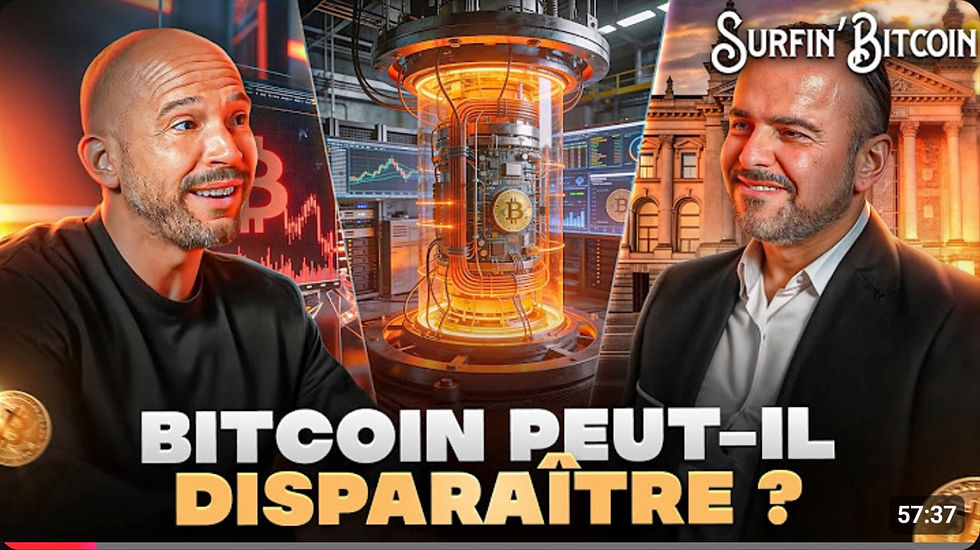
New interview with Michel KHAZZAKA by Surfin Bitcoin with Jonathan Herscovici, published on March 1, 2026, at this link:
Article dedicated to debunking the alleged “risks” of Bitcoin with Michel KHAZZAKA (Valuechain.pro), who structures the analysis across three dimensions: financial, technical, and systemic:
The recent drop (to the $60–65k range) was mainly driven by leverage and ETFs (around 4% of supply), which drained liquidity from a still-limited market without changing the fundamentals. Post-halving cycles and the roughly 18-month lag are also recalled, along with a case for long-term investing and DCA.
On the technical side, Satoshi’s identity or any movement from Satoshi’s wallet does not affect the protocol itself, since governance is driven through BIPs. The quantum risk remains distant (10–20+ years), with possible paths such as BIP-360 and a transition via soft fork. Even a hack of old wallets would likely be absorbed by the market.
As for miners, after 2140 transaction fees should be sufficient, mining difficulty adjusts automatically, profitability depends on price (around $30–40k), and the geographic distribution of hashrate (the US at 30–40% versus China/Kazakhstan/Russia) limits the risk of capture. Even a coordinated 51% attack would remain extremely costly.
On the systemic side, bans tend to fail (for example, Nigeria), because censorship can be bypassed globally. Stablecoins (such as Tether, SG-Forge/Kivalis initiatives, and the MiCA 2 debates) mainly serve as bridges and liquidity tools and may also contribute to inflation, but they will remain complementary. Bitcoin remains the Schelling point and, ultimately, “the best stablecoin.”
Introduction
Jonathan:
We are hearing a lot of things about Bitcoin right now. Bitcoin is going to die, Bitcoin is going to zero. The idea today is to debunk these talking points, especially those coming from the traditional press. But before that, could you briefly introduce yourself for those who may not know you?
Michel:
I am Michel Khazzaka, founder of Valuechain, a consulting firm specialized in payments, blockchain, and crypto payments. For many years, I have been advising banks, merchants, and various players in the payments sector, both in France and internationally. I have had the opportunity to work across the entire payments value chain, from Australia to Canada, and I have been observing Bitcoin since 2010. That has given me time to study it in depth and to help my industry better understand the subject. I also teach blockchain, secure transactions, and Bitcoin at university level, and I contribute to the work of the France Payment Forum. I have also published work on Bitcoin’s energy efficiency compared with the banking sector, as well as on its resistance to censorship.
1. Volatility, price declines, and the perception of risk
Jonathan:
When Bitcoin falls, many people see it as proof that it is a doomed or structurally fragile asset. Does that seem like a fair reading to you?
Michel:
No. Bitcoin’s volatility does not call its fundamentals into question. Bitcoin has always gone through periods of very strong appreciation, followed by major corrections. This kind of movement is part of its nature as an emerging market. What matters is not only the short-term price, but also the strength of the protocol, the dynamics of adoption, and the gradual deepening of the market.
One of the recent developments has been the arrival of new players, especially institutional ones, through ETFs and actors such as BlackRock. This changes market dynamics, brings in new volumes, and can amplify certain phases of correction or speculation. But it does not change Bitcoin’s fundamentals. For a long-term investor, a correction can even be seen as an opportunity to build a position gradually, provided it is approached with prudence and discipline.
2. The risk related to Satoshi and the myth of the “hacked wallet”
Jonathan:
A concern that often comes up relates to Satoshi Nakamoto. Some people wonder what would happen if Satoshi’s identity were revealed, or if his bitcoins were suddenly moved. Is that a real risk for Bitcoin?
Michel:
It is an important topic, but we need to clearly distinguish between symbolic risk and systemic risk. The revelation of Satoshi’s identity could of course create a psychological or media shock, and perhaps even a market shock. But it would not undermine the functioning of the protocol itself. Bitcoin does not depend on the active presence of its creator. It works precisely because it has emancipated itself from any central figure.
The real technical question is not so much Satoshi’s identity as the security of cryptographic signatures if, one day, certain technological capabilities were to compromise them. That is where the discussion becomes truly serious.
3. The technological risk: quantum computers
Jonathan:
Let us turn precisely to the technological risk. One question that comes up often, including among our clients, is this: could quantum computers one day hack Satoshi’s wallet, or other wallets, and steal the bitcoins?
Michel:
It is a serious issue, but it is often poorly framed. First, it is worth recalling that in the banking sector and among central banks, work is already under way today on protocols designed to be adaptable to the quantum era. These new systems are not necessarily “quantum-proof” from day one, but they are designed in a way that allows them to evolve in that direction.
Bitcoin, for its part, was not originally designed with that constraint in mind, simply because it was not a central issue at the time it was created. But we need to be precise: Bitcoin does not encrypt data in the same way a privacy system would. Bitcoin is a public ledger. Everything is visible. Its security model does not rely on opacity, but on transparency, verifiability, and the collective robustness of the system.
The sensitive point, then, is not content encryption, but the signature. The theoretical risk would be that an actor could break a cryptographic signature and sign in place of another user. That is what must be protected. Today, the signature scheme used by Bitcoin is very secure, but it is not yet, strictly speaking, quantum-resistant. It is a real issue, but not proof that Bitcoin is doomed in the short term. Paths for adaptation already exist.
4. Mining, monetary issuance, and the economic future of the network
Jonathan:
Another topic that comes up often is this: if block rewards keep decreasing over time until they disappear, will miners still have an incentive to secure Bitcoin?
Michel:
Here again, we need to move beyond simplistic shortcuts. The fact that monetary issuance gradually declines does not mean that miners’ economic incentive will suddenly disappear. First, this evolution plays out over an extremely long period of time. Second, miners’ compensation does not rely only on the block subsidy, but also on transaction fees.
If Bitcoin continues to increase in value, and if its use as a monetary infrastructure or reserve asset continues to strengthen, then fees can play an increasingly important role in the mining economy. So it is wrong to say that the gradual end of issuance would automatically mean the end of the network’s economic security. We need to look at the overall dynamic, not just one isolated parameter.
5. Mining centralization and attack risks
Jonathan:
Some also worry about the concentration of mining in certain countries or among a small number of large players. Can that centralization threaten Bitcoin?
Michel:
There is indeed a geopolitics of mining, and it deserves to be monitored seriously. But that does not mean that a credible attack against Bitcoin would be easy or likely today. Even in the extreme scenario where very large powers decided to coordinate an attack, the economic cost would be colossal.
In theory, one could imagine a group of states attempting a double-spend attack. But even if they managed to do so, it would cost them enormously, and above all it would run counter to their own strategic interests. Game theory shows precisely that the incentive structure makes this kind of attack highly irrational. So the risk is not zero in a purely theoretical sense, but it does not appear credible in the real world today.
6. Can states ban Bitcoin?
Jonathan:
Let us move to the final major section: systemic, political, or strategic threats. One question that often comes up is: what would happen if states banned Bitcoin?
Michel:
First, it should be recalled that they have not really done so. Regulations such as MiCA do not target Bitcoin itself in an existential way; they mainly regulate other segments, especially stablecoins. In reality, Bitcoin remains very difficult to target directly as a global protocol.
I often use this image: Bitcoin is like a fighter jet that people try to shoot down, but which releases decoys behind it. Many regulatory or media attacks focus on what surrounds it — altcoins, stablecoins, intermediaries — rather than on Bitcoin itself.
Of course, some risks do exist: taxation, reporting obligations, potentially more aggressive taxation in certain countries. But at this stage, these are not systemic risks capable of “killing” Bitcoin. To truly neutralize Bitcoin on a global scale, it would require an extremely high level of international coordination, with the ability to impose homogeneous constraints on all participants in the network. And even in that case, its neutrality would remain very difficult to break. If a miner in one country refuses to process certain transactions, a miner in another jurisdiction can include them. The network thus retains a very strong resilience against censorship.
7. Bitcoin, stablecoins, and monetary warfare
Jonathan:
Within that geopolitical logic, how do you position Bitcoin relative to stablecoins and broader international monetary issues?
Michel:
Stablecoins play an important role as infrastructure for transition, circulation, and adoption. They can serve as a bridge within the ecosystem. But they do not replace Bitcoin in its core value proposition. Stablecoins remain tied to fiat currencies and operate within different frameworks of sovereignty, issuers, and regulation.
Today there is a real sovereignty issue, especially in Europe, in response to the dominance of foreign players in the stablecoin space. This raises questions of interoperability, control, and monetary influence. But precisely for that reason, it shows that Bitcoin and stablecoins are not in the same category. They can coexist with fiat currencies, each with its own utility. Bitcoin retains a unique place as a decentralized, global monetary asset.
Conclusion
Jonathan:
If you had to sum it up, ultimately, is Bitcoin really in danger?
Michel:
Bitcoin faces serious debates, real technical challenges, and major geopolitical issues. But many of the alarmist scenarios put forward in public debate are more the result of fantasy, oversimplification, or a poor understanding of the system than of an immediate and credible threat.
Quantum risk is something to anticipate, not an imminent condemnation. The gradual end of monetary issuance does not mean the disappearance of miners’ incentives. States may complicate certain uses or points of access, but they do not easily neutralize a global, distributed, and resilient protocol. In that sense, Bitcoin is not without risks. But it is often far less vulnerable than people say — and sometimes far more robust than its critics are willing to admit.


Comments